Are your prompts too long?
In our last co-working session at the AI club for accountants, we ran an experiment - a prompt party!
Everyone brought the prompt they use for their GST reviewer agent.
We shared them all, and we tried each other's. It was a lot of fun.
They all found the same problems
Every prompt was different.
Ben had built his into a full agent and trusted it to know GST, so he simply told it to go and check, and didn't point it at anything. Louise had gone the other way and fed hers the IRD guidelines to work from. Lauren's opened with one sharp line: "You are the GST review agent for an Australian accounting firm." We had prompts that ran a couple of paragraphs, and a prompt that was 11 pages.
We experimented with them all.
Marc ran the whole lot over the same file, one he already knew had errors hiding in it. Every one of them surfaced the same issues.
His words:
Everyone's taken a different approach, but they've all picked up exactly the same issues.
So the magic was never in how long the prompt was, how complicated it was, or the exact wording. There is no golden prompt.
The shortest prompts won
Every prompt found the problems. The difference was in what came back: how clear and succinct the response was, the suggestions for next steps, and whether the AI noticed something ambiguous and surfaced it or sailed right past it.
Some of the shortest prompts became the most popular ones to borrow.
That goes against what most of us were taught. We learned that a good prompt is a long prompt. It gives a lot of context. It spells out every instruction. Leaves nothing to chance.
That used to be right. The older AI models needed it, or they made things up.
Today’s models think and reason, and the old advice no longer stands.
Tell it the goal, not the steps
What’s changed is the models got very smart. Smarter than any prompt we can write.
It’s like hiring a very capable employee. You do not hand them a script and ask them to follow it line by line. You explain what you are trying to achieve, name the constraints that matter, then let them work out the details: "Here is what I am trying to achieve. How do you think we can do it best? Great, let’s do it." If you hired well, they will probably do it better than you would.
It also comes from the people who build these tools.
Anthropic, who make Claude, now say it in their prompting guide: "Prefer general instructions over prescriptive steps." And the reason why: "Claude's reasoning frequently exceeds what a human would prescribe."
OpenAI say the same about their reasoning models in their best practices guide: "Keep prompts simple and direct." They go further. Old techniques like instructing the model to think step by step "may not enhance performance (and can sometimes hinder it)".
Dictating less gives you a smarter AI.
Script every step and you cap the AI at your own thinking.
Give it the goal and the room to reach it, and it can go further than you would have.
So the new guideline is:
Be precise about what you want. Loose about how to do it.
Clear on the goal and the things that matter. Quiet on the method.
Your AI will often surprise you.
Keep control by checking the work
I can hear the worry, because I had it too: if I give the AI that much freedom, how do I stay in control?
You do not stay in control by caging the instructions. You stay in control by checking the work.
And you already do this every day. A preparer does the job. The AI helps them perfect it. Then the human reviewer checks it.
Except that now, the human reviewer spends six minutes and one iteration instead of the old grind. The human reviewer still signs off, because we still hold the accountability.
Our members Louise and Sarah took it a step further. They had the AI build a review tab straight into the spreadsheet, with the findings, an action column and an approval status, so a manager can run their eye down it and sign off. Easier for the manager, and you get a record of everything the AI spotted and suggested.
What to try this week
Take a prompt you already use. Cut it back. Strip out the step-by-step and leave the goal and the few things that really count. Brief it the way you would brief a smart, senior employee. Run it and see what happens.
What do you find?
Do you feel like you need a second prompt to verify the results of the first one? That’s often a sensible step. And because your prompt describes the goal, not the steps, your results will keep improving as the models improve.
We worked this out together
I only get to share this with you because we figured it out as a group. We put our prompts on the table, tried each other's, and learned more in an hour than any of us would have in a month on our own.
We have more geeky parties like this coming. The July intake is closing this week. If you want in, and the notes from this one, do it now: inbal.com.au/aiclub.
We've got this.
-
Inbal Rodnay
Guiding Firms in AI Adoption and Automation
Keynote speaker | AI Workshops | Executive briefings | The Tech Savvy Firm
When you are ready, here is how Inbal can help:

AI with Inbal
- Meetups: See what other firms are actually doing: real use cases, real results, no polish.
- The Radar: What to act on now, what to watch, and what to safely ignore
- The resource hub: prompt packs, policy templates, and implementation guides
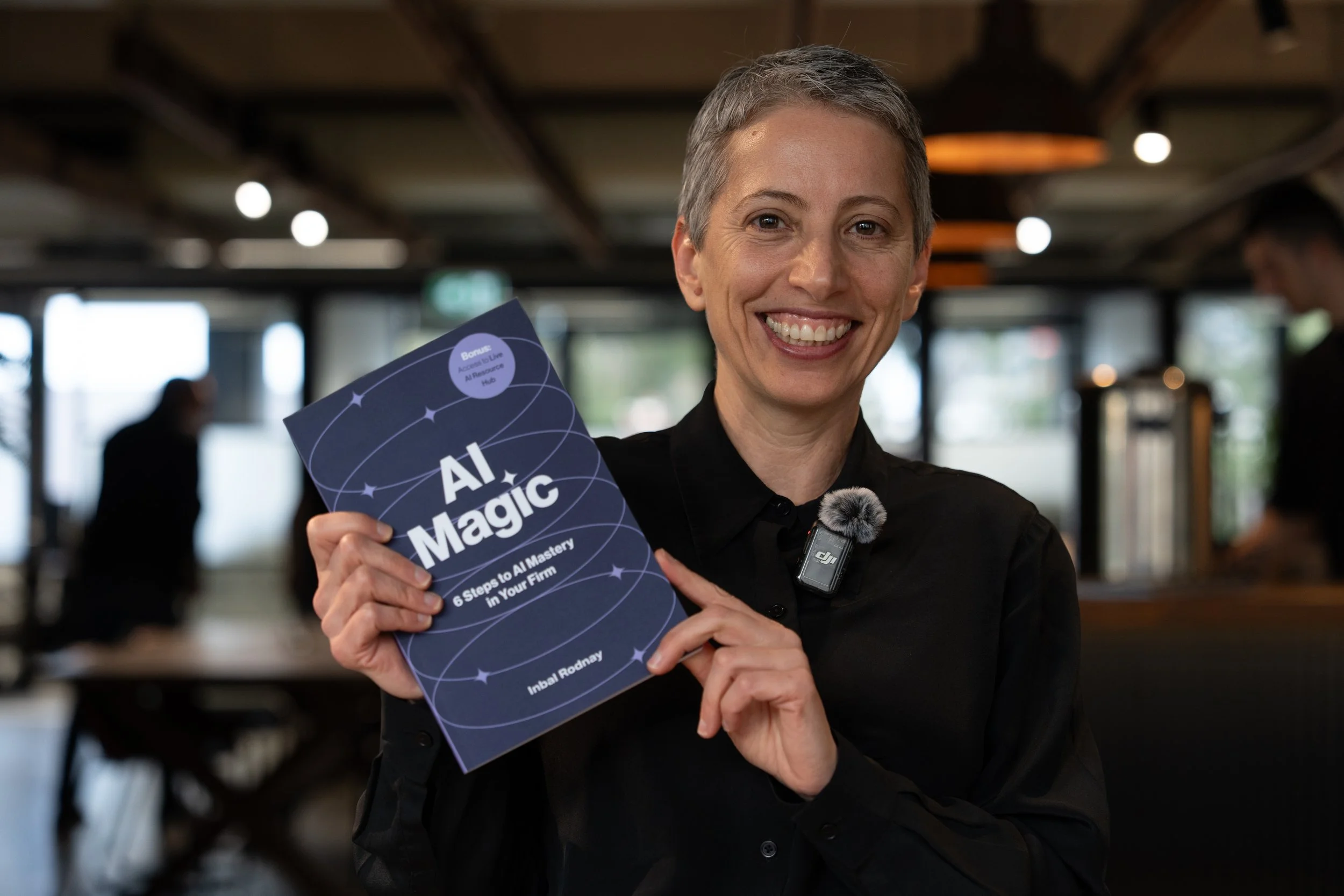
AI Magic: 6 Steps to AI Mastery In Your Firm:
- A step-by-step roadmap that shifts your firm from dabbling to safe, impactful AI Adoption
- A hands-on guide for mastering AI in your firm, solo practice, or team.
- Access to a live AI Resource Hub
AI Bootcamp in Sydney
- Practical, business-safe AI use cases
- How to move from “sporadic prompting” to real workflow
- What AI agents are, and what they can do for you right now

AI Bootcamp in Melbourne
- Practical, business-safe AI use cases
- How to move from “sporadic prompting” to real workflow
- What AI agents are, and what they can do for you right now