Accountants reconsider their app spend
Last year you got good at asking AI questions.
This year the question is different: what will you hand over to it entirely?
That's the shift from a prompt to an agent. A prompt gets you an answer. An agent goes and does the job.
And accountants are starting to build them. Which means they are also starting to stop paying for software.
What they are handing over
Last week, one of the accountants in our AI club shared their screen and showed us a tool they had built for drawing group structure diagrams. Entities, trusts, relationships. You move them around and connect them, or you just ask it in plain English to add a holding company, 20% to this person and 80% to that one, and it applies it.
Someone asked for the prompt. They shared it in the chat.
That afternoon another member posted. She had taken that prompt and built the same thing for her firm. The partners had already agreed to spend a few thousand dollars on a tool that does exactly that.
She got to tell them: don't. We've got it.
And I thought, wow. This is happening.
So I got a group of the accountants in the club together and asked them. What are you building? And what are you not going to pay for anymore?
I'll give you the answers that came back:
Engagement letters. Done with AI now, with a repeatable skill. The app subscription is not being renewed.
Workpapers. A whole year trying an app that never got to be exactly how she wanted it. She spent a day with AI and rebuilt them. She did it in Copilot Cowork, so we could see the exact tokens and what it cost her: under $1,000 in usage. The workpapers are in Excel now, working exactly how she likes them for her whole team, and she keeps the IP and can change whatever she wants whenever she wants.
A GST agent. One of our members met that morning with a software development company that wanted to build GST automation for him. He shared his screen and showed them the GST agent he had built a couple of weeks earlier with a few simple prompts. That one is heartbreaking, if you're the software company.
Reporting and cashflow. Replaceable with dashboards built off the new Xero connector. And the home-built version works whichever ledger the client is on, which the paid one does not.
Financial planning software. Going. The projection model that was actually needed is built.
And me.
I have a folder now. I drop the receipts from my travels into it and that's the end of my involvement.
The agent picks them up and sends them into Xero. As spend money transactions, not as bills, which is what most of the apps do.
I handwrite notes on those receipts and the AI takes them into account. This was personal. This was business. Put the shuttle from the hotel to the airport in the line description.
It doesn't cost me anything to run.
There are so many examples.
Two shapes of the same thing
Some of these are agents in the background. Nobody opens them. My receipts folder is one. It runs, and I am not in the loop.
Others are small apps you open and use. The group structure diagram tool is one of those. So are the rebuilt workpapers.
That second kind is where the subscriptions die. When the thing you built is an actual app your team opens, it is competing directly with the app you were paying thousands a year for. And once you have built one, you look at that invoice differently.
Same skill either way. You describe the job and AI writes it.
What is actually happening here
AI is really good at coding. It is one of the things it is best at.
And accountants are starting to figure out that you can just ask it to build the thing.
It has become so simple to do.
Go to your favourite AI. Claude, ChatGPT, Microsoft Copilot, Gemini, whichever one you use.
Say: I want to build something that does this, this and that. What do I need to consider?
Then: write me the prompt.
Then run the prompt.
That's it.
Why we are keeping it to small jobs today
Well-defined tasks. Not entire systems. Not the practice management system, not the accounting system, not the lodgement app.
Why?
One barrier is the integrations. They are still a bit hard to do. Not impossible, many of us do it, and I have mine working with Xero. But it is a bit of a thing. Getting data in and out of other systems is still tricky.
Another is the source of truth. I would not replace my accounting app today with one my AI manages. If anything goes wrong there, if I miss something, if I give it the wrong guidance, I end up with wrong data. And I cannot afford that.
Another is letting your clients use it. Then you have the liability of looking after their data. What if something goes wrong with that?
And there is the whole area of security. One of our members talked about this. If people build their own CRM, they are managing other people's information in an app they built themselves. Do we understand the security implications? Do we know what it takes to keep that data safe, responsibly?
But something small and very well defined, like a group structure diagram you can review and be sure is 100%?
I don't see a reason not to.
So what should you do?
Two things.
One, give it a go. Go to your favourite AI and ask it to build you something small.
A group structure diagram tool. Or something that takes a folder and organises what's in there into a spreadsheet. Whenever you ask for it, or every day at 10am, or every hour.
Or a game. My son does that all the time to help him prepare for exams at school.
It is not hard to do.
Two, once you have that feeling in your fingers for what is possible, start looking at your expenses.
What apps are you paying for? What would you consider replacing with your own, where the risk is very low?
What are you paying for that you are only using 20% of?
And is that 20% the heavy lifting? The integrations, bringing the data in, keeping it safe?
Or is it just a utility, where the risk is low and you could probably build it yourself?
Then put a reminder in to do that review every three months. The capabilities keep getting better, and it keeps getting easier.
If you are not building an agent yet
Do not worry. You are not behind yet.
2025 was the year of prompts. You got good at asking, and AI got good at answering.
2026 is the year of agents. You give AI a job and it goes and does it. Not a better answer, actual work done.
Right now this is still an early adopter capability. Not many people are doing it. A few people up ahead are.
But if you get to the end of this year without having built one, you will be behind. Not catastrophically. Just a little, and it compounds.
So it might be worth experimenting with.
You've got this!
--
Inbal Rodnay
Guiding Firms in AI Adoption and Automation
Keynote speaker | AI Workshops | Executive briefings | The Tech Savvy Firm
When you are ready, here is how Inbal can help:
AI for Accountants Club
- Meetups: See what other firms are actually doing: real use cases, real results, no polish.
- The Radar: What to act on now, what to watch, and what to safely ignore
- The resource hub: prompt packs, policy templates, and implementation guides
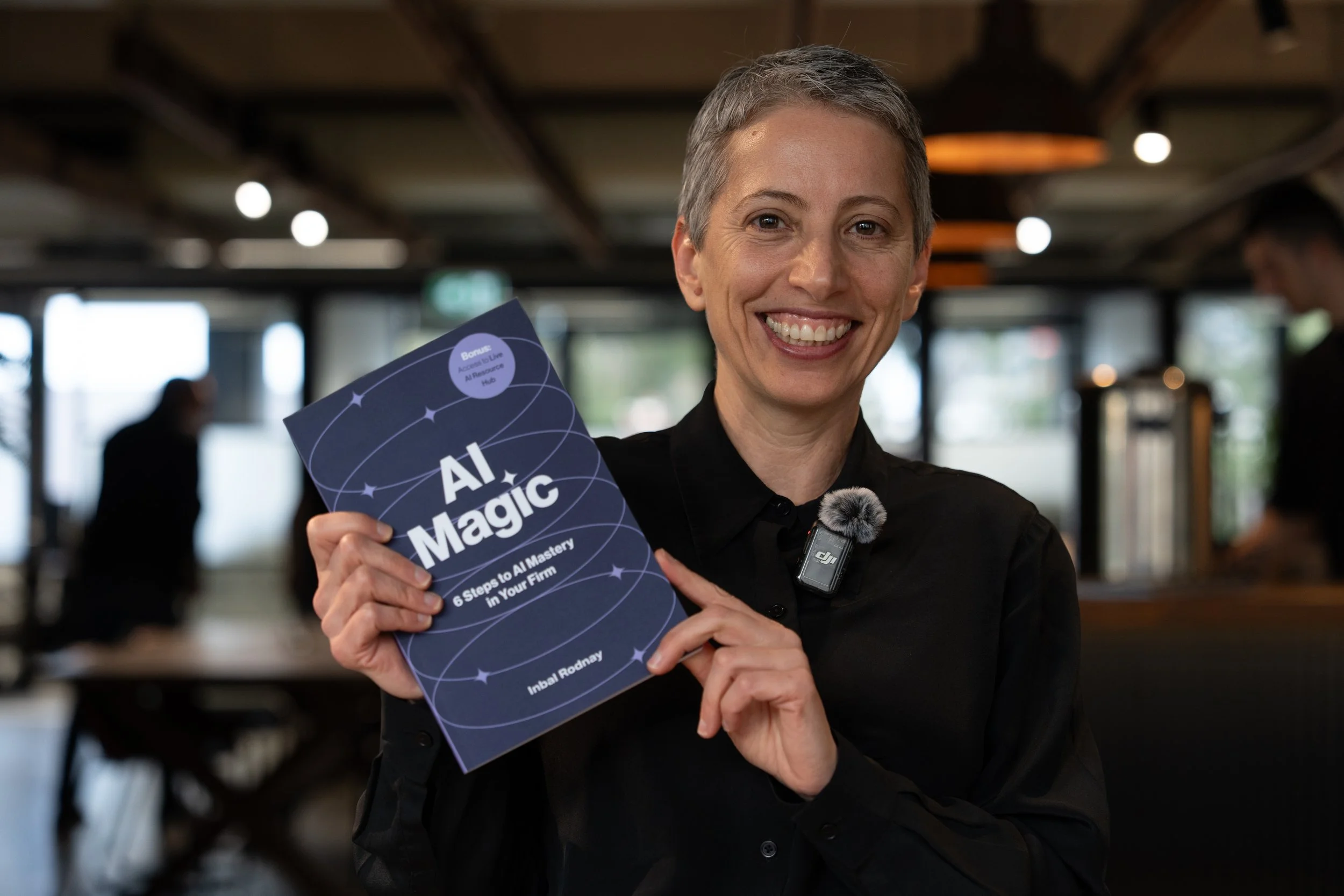
AI Magic: 6 Steps to AI Mastery In Your Firm:
- A step-by-step roadmap that shifts your firm from dabbling to safe, impactful AI Adoption
- A hands-on guide for mastering AI in your firm, solo practice, or team.
- Access to a live AI Resource Hub
GST Reviewer Workshop
- A real AI agent of your own, built live in your own Microsoft Copilot
- Not a demo, you watch
- A list of 32 agents that other firms are building that you can build the same way.